IV Stem Cell Infusion vs Targeted Injection: Which Is Right for You?
- Written by
- StemCell Longevita Editorial Team
- Medically reviewed by
- Prof. Dr. Erdal Karaöz TeamProfessor of Histology and Embryology · Medical Director, Center for Regenerative Medicine
- Last reviewed
- Next scheduled review
How we evaluate evidence · Conflict-of-interest disclosure · Editorial standards
Background explainer. Written for readers researching a condition or treatment before deciding anything.
The route of administration matters as much as the cell product. A guide to IV, intra-articular, intrathecal, and intranasal MSC delivery — and how to choose the right one for your condition.
Five Main Delivery Routes for Stem Cell Therapy
When patients research stem cell therapy, the conversation usually centres on cell type — autologous versus allogeneic, Wharton's jelly versus bone marrow. The route of administration receives much less attention, but it is just as important. The same cell product delivered intravenously, into a joint, into the spinal fluid, or into the nasal cavity reaches different tissues, in different concentrations, and produces different therapeutic effects.
In 2026 clinical practice, five primary delivery routes are used: intravenous (IV) infusion for systemic effect, intra-articular injection into a specific joint, intrathecal injection into the spinal fluid for nervous-system targeting, intranasal delivery to access the brain via the olfactory route, and intramuscular or local soft-tissue injection for tendon, ligament, or muscle conditions. Some protocols use only one route; many of the most effective protocols combine two or more.
Choosing the right route is not about preference — it is about pharmacology. Where does the cell product need to act? How does it get there? What proportion of the dose actually reaches the target tissue, and what proportion is filtered out before it gets there? This guide walks through the trade-offs so you can have an informed conversation with your treating physician.
IV Infusion: Systemic Whole-Body Delivery
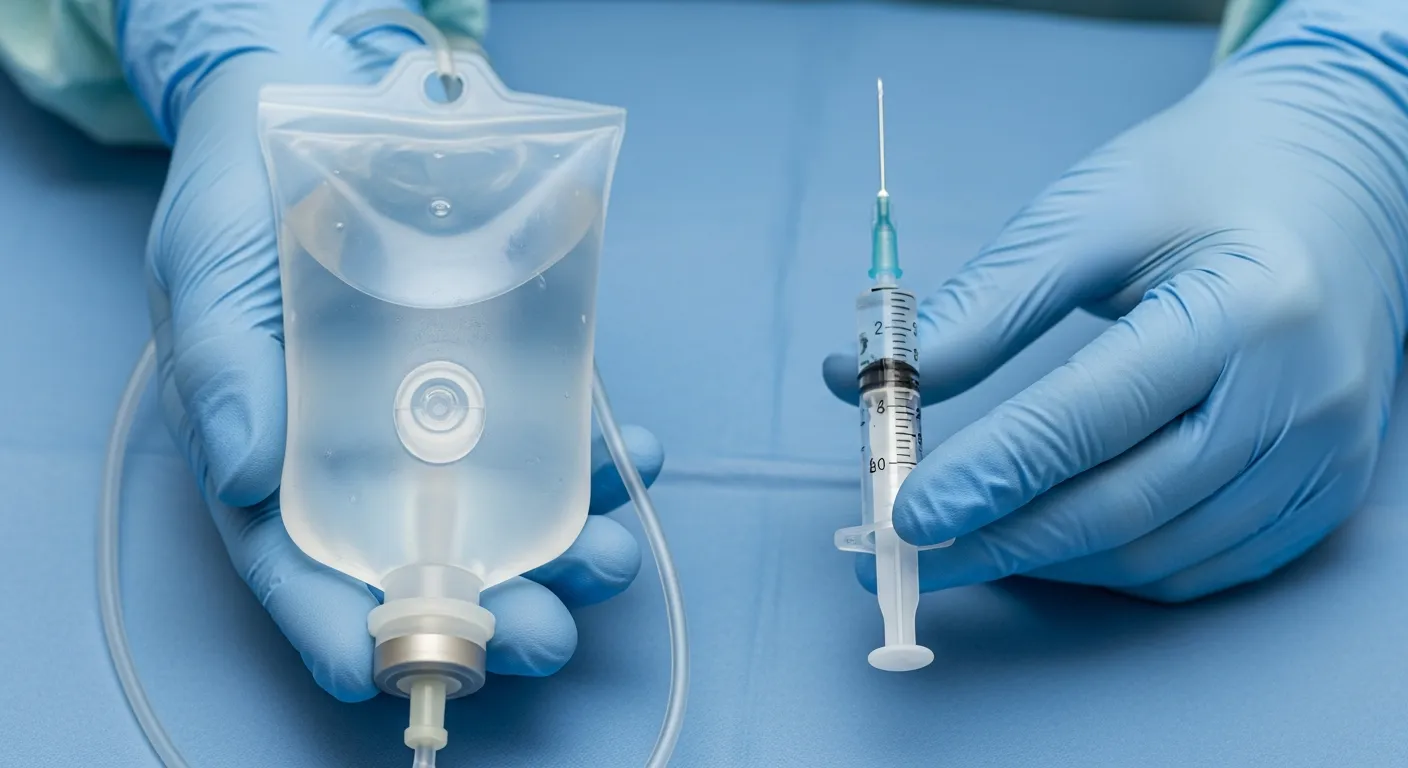
Intravenous infusion is the most common stem cell delivery route worldwide. Cells are infused into a peripheral vein and circulate through the body via the bloodstream.
How It Works
Cells enter peripheral circulation, are filtered first through the lungs (where most initially lodge), then redistribute over hours and days to sites of inflammation throughout the body.
Best For
Systemic conditions: autoimmune disease, chronic inflammation, multi-system Long COVID, anti-aging, generalised pain syndromes, multi-joint arthritis.
Mechanism
Largely paracrine signalling. The infused cells release anti-inflammatory cytokines and growth factors throughout the body even though most cells themselves are cleared within days to weeks.
Procedure Time
60-90 minutes per infusion in an outpatient setting. No anaesthesia, no incisions, no hospitalisation required for the infusion itself.
Lung Filtering Reality
An estimated 60-80% of IV-infused MSCs lodge initially in the pulmonary microvasculature. This is not necessarily wasteful — many therapeutic effects originate from the cells signalling from this position.
Limitations
Limited cell concentration reaches any specific localised target. For a single severely damaged joint, IV alone delivers a much smaller dose to that joint than a targeted intra-articular injection.
Targeted Injection: Concentrated Local Delivery
Targeted injection delivers cells directly into the tissue or compartment where they are needed most, achieving much higher local concentrations than systemic delivery.
Intra-Articular (Joint)
Direct injection into a joint capsule under ultrasound guidance. Standard for knee, shoulder, hip, ankle conditions. Achieves high local cell concentration in the joint synovial environment.
Intrathecal (Spinal Fluid)
Injection into the cerebrospinal fluid via lumbar puncture. Allows direct access to the central nervous system. Used for MS, ALS, spinal cord injury, severe neurological conditions.
Intramuscular
Local injection into specific muscles or tendon-muscle junctions. Used for sports injuries, focal tendinopathy, and certain post-stroke or post-traumatic muscle conditions.
Intranasal
Cells or exosomes delivered into the nasal cavity, providing partial access to the brain via the olfactory and trigeminal pathways. Used as adjunct in autism, Parkinson's, cognitive aging.
Local Soft-Tissue
Direct injection into specific damaged tissue under imaging guidance — e.g. into a torn tendon, scar tissue, or a non-healing wound. Maximum local concentration at the precise target.
Intracoronary / Catheter
Specialised cardiology delivery via cardiac catheterisation directly into coronary arteries. Used in selected cardiovascular regeneration protocols at specialist centres.
Direct Head-to-Head Comparison
Intravenous (IV) Infusion
- Systemic effect across multiple organs
- Best for inflammatory, autoimmune, and multi-system disease
- Simple outpatient procedure, no imaging required
- Can be repeated frequently with minimal procedural risk
- Lower local concentration at any single target
- Ideal as the foundation of a multi-system protocol
Targeted Injection
- Maximum local concentration where it is needed
- Best for localised joint, spine, or tissue conditions
- Requires imaging guidance (ultrasound, fluoroscopy)
- More procedural complexity and recovery considerations
- Limited systemic effect beyond the target tissue
- Often combined with IV for comprehensive protocols
Which Route for Which Condition?
Indicative guidance based on current 2026 clinical practice. Your individual protocol should be tailored to your specific case.
Why Combination Protocols Often Win
The most effective stem cell protocols in 2026 frequently combine routes rather than relying on a single delivery method. The reason is biological: the body is a system, and most chronic conditions involve both a systemic component (chronic inflammation, immune dysregulation) and a local component (a specific damaged tissue). Treating only one half of the picture can deliver only half the result.
A typical combination protocol for severe knee osteoarthritis might include a targeted intra-articular injection delivering 30-50 million cells directly into the joint, combined with an IV infusion of 100-150 million cells for systemic anti-inflammatory effect and to address related joint and soft-tissue inflammation elsewhere in the body. The two routes are complementary: the targeted injection addresses the worst-affected tissue, the IV infusion calms the broader inflammatory environment that otherwise undermines local healing.
For complex neurological conditions, a triple-route protocol — IV for systemic inflammation, intrathecal for CNS access, and sometimes intranasal for olfactory-pathway brain access — is increasingly standard at experienced centres. The cost is higher, the protocol is more complex, but the outcomes data supports the additional intervention for severe and treatment-resistant cases.
Frequently Asked Questions
International Patient Coordination
StemCell Longevita operates as an international patient coordination platform. We connect patients with licensed medical institutions that provide regenerative medicine applications following physician evaluation and applicable regulatory frameworks. All medical decisions and procedures are conducted exclusively by authorized healthcare professionals. StemCell Longevita does not directly provide medical treatment.
Medical Disclaimer
The information provided on this website is for educational and informational purposes only and is not intended as medical advice. Stem cell therapy is an evolving field, and outcomes may vary by individual. The treatments described on this site have not been fully evaluated or approved by the FDA or equivalent regulatory bodies in all jurisdictions.
The FDA has not approved stem cell applications for most conditions listed on this website. Results mentioned are based on clinical observations, published research, and patient-reported outcomes. Individual results may vary and no specific outcomes are assured for any individual patient.
Inclusion of scientific publications on this website does not imply regulatory approval, and does not imply any clinical outcome for an individual patient. Certain applications may be considered investigational depending on indication and jurisdiction.
Always consult with a qualified healthcare professional before making any medical decisions. Do not disregard professional medical advice or delay seeking treatment based on information found on this website.
Related clinical questions
Where this page sits in the wider picture.